研究内容Research
音響圧縮センシングによる複雑流動場イメージング Acoustic compressed sensing for reconstructing complex flow fields
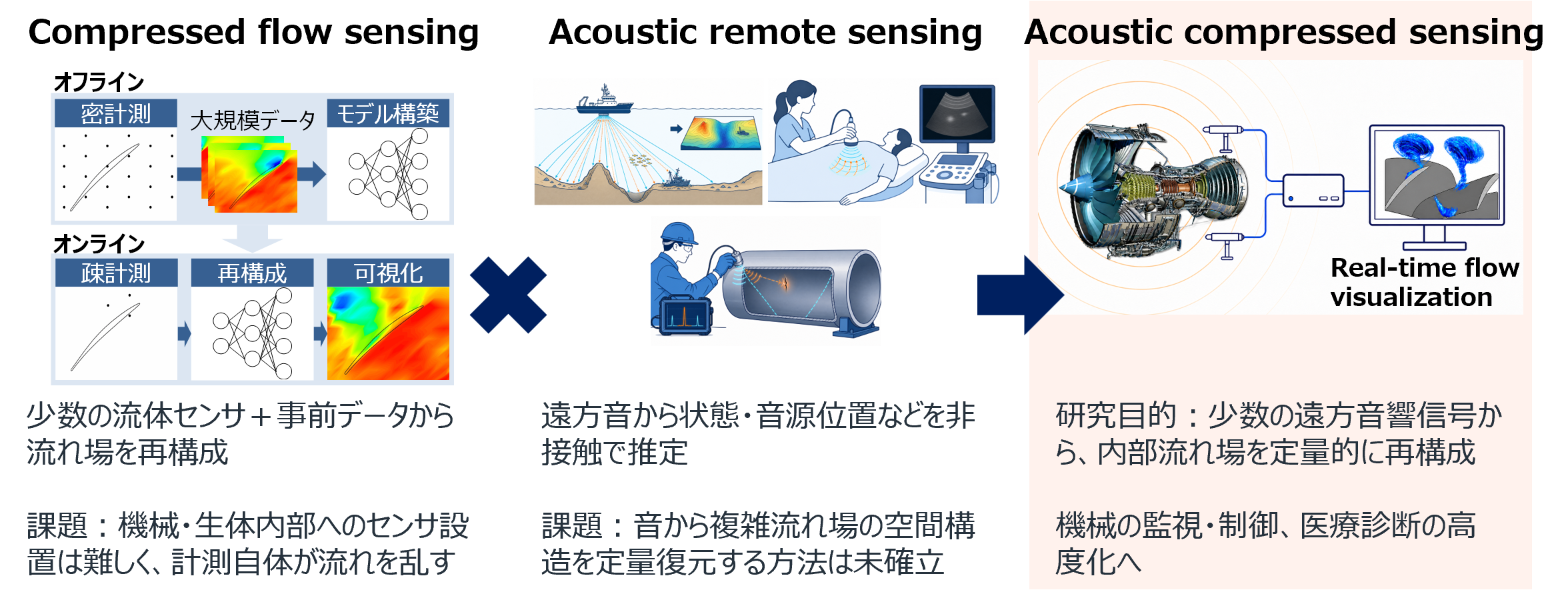
音の計測を通じて音源の状態を把握する「音響リモートセンシング」は、海底探査や機械音源の可視化など、さまざまな分野で活用されています。しかし、流れの強い非線形性や高次元性のため、音響信号だけから流れの詳細な構造を捉えることは容易ではありません。本研究室では、機械学習と物理法則に基づく逆解析を融合し、限られた音響信号から目に見えない流れ場の状態を再構成する新しい手法の開発に取り組んでいます。これにより、航空機エンジンや風力タービンにおいて、失速の前兆となるわずかな流れの変化を非侵襲的かつリアルタイムに捉え、流れの制御の高度化につなげることを目指しています。
Acoustic remote sensing, which uses sound measurements to infer the state of a source, is used in various fields, including seafloor exploration and the visualization of mechanical sound sources. However, the strong nonlinearity and high dimensionality of fluid flows make it difficult to capture detailed flow structures from acoustic signals alone. Our laboratory is developing a new method to reconstruct otherwise invisible flow fields from limited acoustic signals by combining machine learning with inverse analysis based on physical laws. Through this approach, we aim to detect subtle flow changes that precede stall in aircraft engines and wind turbines non-intrusively and in real time, contributing to more advanced flow control.
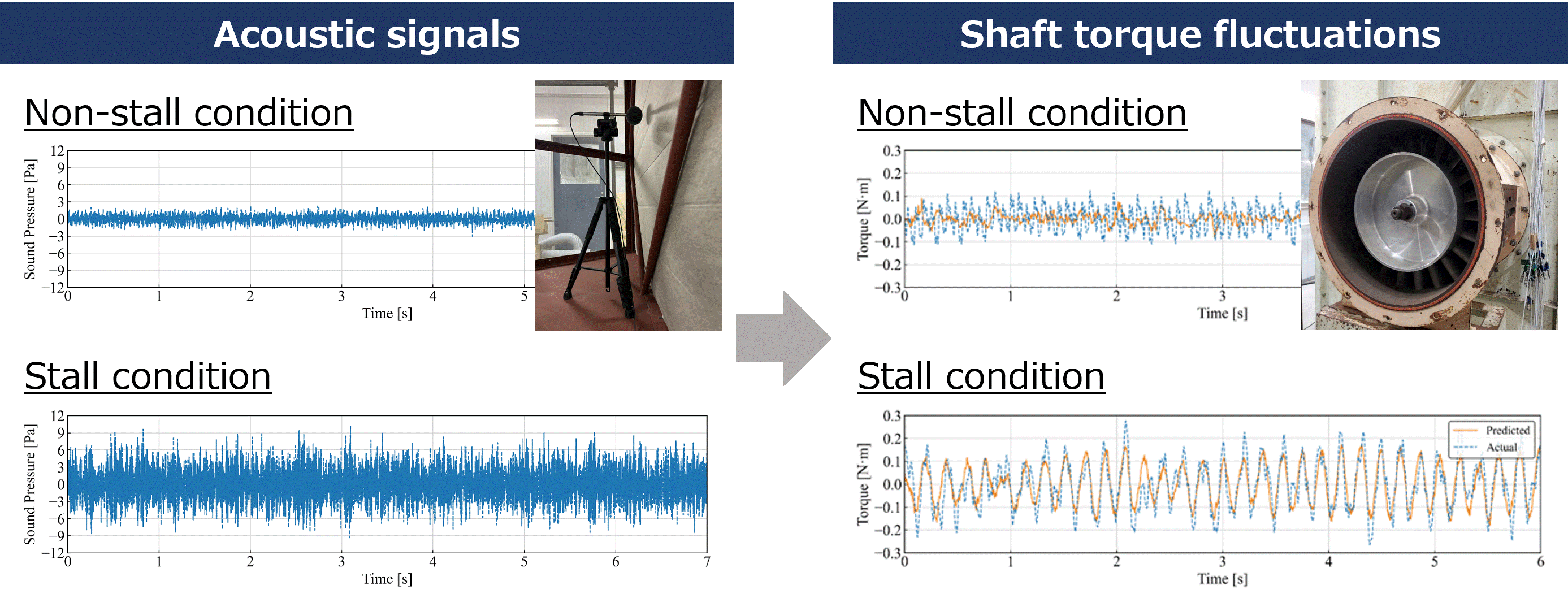
航空機エンジン用軸流圧縮機の音響信号から軸トルク変動の再構成
Reconstruction of shaft torque fluctuations from acoustic signals in an aircraft
engine axial compressor
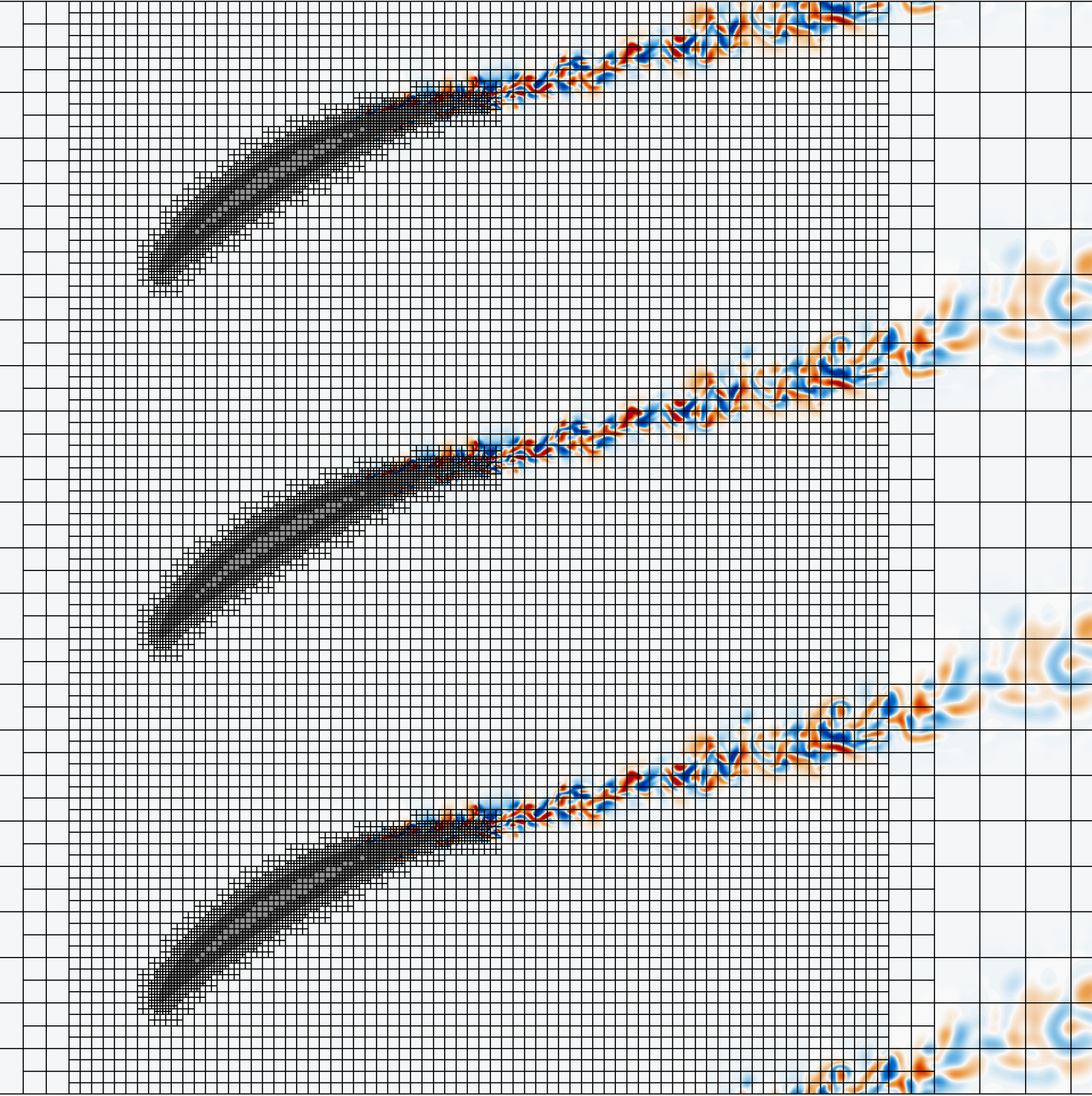
ターボ機械の複雑な非定常流動現象の解析Analysis of complex unsteady flow phenomena in turbomachinery
圧縮機やファンなどのターボ機械では、動翼まわりに生じる剥離や渦の非定常な挙動が、機器の性能や騒音に影響を及ぼします。本研究室では、スーパーコンピュータを活用した大規模数値解析により、これらの複雑な流れの構造と時間変化を捉え、そのメカニズムの解明に取り組んでいます。特に、並列計算に適した格子ボルツマン法(LBM)を圧縮機やファンに適用するため、独自の解析技術を開発しています。こうした技術開発と現象解明を通じて、ガスタービンや空調機などの高効率化・低騒音化に向けた設計に役立つ知見を得ることを目指しています。In turbomachinery such as compressors and fans, flow separation and unsteady vortex dynamics around rotating blades affect performance and noise. Our laboratory uses large-scale numerical simulations on supercomputers to investigate the structure and evolution of these complex flows and clarify the underlying mechanisms. In particular, we are developing our own simulation techniques to apply the lattice Boltzmann method (LBM), which is well suited to parallel computing, to compressors and fans. Through these methodological developments and investigations of flow phenomena, we aim to provide insights that support the design of more efficient and quieter gas turbines, air-conditioning systems, and related equipment.
圧縮機翼列へのLBMの適用Application of LBM to a compressor cascade
空調用横流ファンの流体音響解析
Aeroacoustic simulation of a cross-flow fan for air conditioning
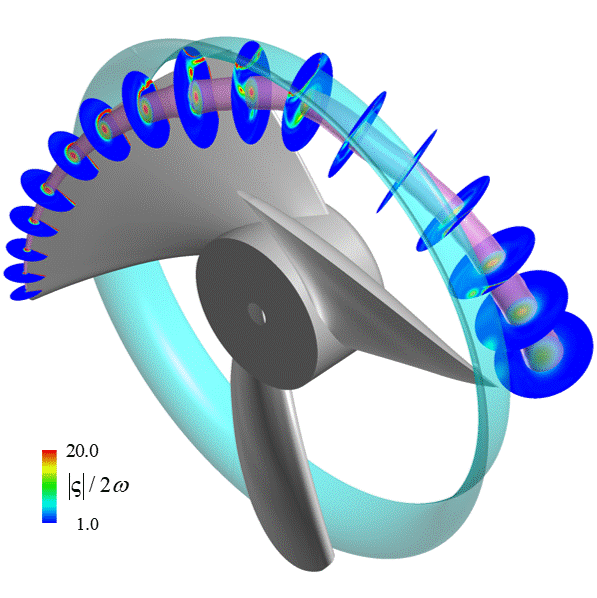
空調用軸流ファンの翼端渦の可視化
Visualization of tip vortices in an axial-flow fan for air conditioning
格子ボルツマン解析による流体騒音発生機構の解明 Lattice Boltzmann simulations for elucidating aeroacoustic noise generation mechanisms
本研究では、格子ボルツマン法(LBM)に基づく流れ場と音響場の連成解析技術を開発し、流体音の発生・伝播・吸収過程を一貫して解析できる手法の構築に取り組んでいます。この技術を基盤とするスーパーコンピュータを用いた大規模解析により、流体騒音(空力騒音)の発生・伝播メカニズムを解明し、航空機・自動車・風車・家電・空調機器などの低騒音化に貢献することを目指しています。
In this research, we develop coupled flow and acoustic simulation techniques based on the lattice Boltzmann method (LBM) and work toward a method that can consistently simulate the generation, propagation, and absorption of flow-induced sound. Using large-scale simulations on supercomputers based on this technology, we aim to elucidate the mechanisms of flow-induced noise (aeroacoustic noise) generation and propagation and contribute to noise reduction in aircraft, automobiles, wind turbines, home appliances, and air-conditioning equipment.
NACA0012翼から発生する乱流音の解析
Broadband sound from an isolated airfoil
円柱のエオルス音の解析
Aeolian tone
キャビティ音の解析
Cavity tone
垂直軸風車の流体音響解析
Aeroacoustic simulation of a vertical-axis wind turbine
アジョイント法に基づく非定常空力設計技術の開発 Development of unsteady aerodynamic design techniques based on the adjoint method
近年、数値解析技術の進展により、機器の設計段階で空力騒音の予測や音源の同定が可能になりつつあります。しかし、こうした順解析だけでは、流体音の発生を抑えるための設計指針を直接導くことは困難です。本研究室では、流体音響問題を対象として、格子ボルツマン方程式に基づく随伴法(アジョイント法)を用いた逆解析手法を構築しています。この手法を用いて、流体騒音の低減に有効な形状を効率的に導出し、自動車や航空機などの輸送機械、ファンや風車などの流体機械における新たな空力騒音低減技術の創出につなげることを目指しています。
Advances in numerical simulation are making it increasingly possible to predict aeroacoustic noise and identify sound sources at the equipment design stage. However, forward analysis alone cannot directly provide design guidelines for suppressing flow-induced sound. Our laboratory is developing an inverse analysis method for aeroacoustic problems using an adjoint method based on the lattice Boltzmann equation. Using this method, we aim to efficiently identify shapes that reduce flow-induced noise and contribute to new aeroacoustic noise reduction technologies for transportation systems such as automobiles and aircraft, and fluid machinery such as fans and wind turbines.
流体音の順解析と逆解析
Forward and inverse aeroacoustic analysis
形状最適化によるキャビティ音の低減
Reduction of cavity tone